

Rascals case in brief
In the beginning, in 1989, more than 90 children at the Little Rascals Day Care Center in Edenton, North Carolina, accused a total of 20 adults with 429 instances of sexual abuse over a three-year period. It may have all begun with one parent’s complaint about punishment given her child.
Among the alleged perpetrators: the sheriff and mayor. But prosecutors would charge only Robin Byrum, Darlene Harris, Elizabeth “Betsy” Kelly, Robert “Bob” Kelly, Willard Scott Privott, Shelley Stone and Dawn Wilson – the Edenton 7.
Along with sodomy and beatings, allegations included a baby killed with a handgun, a child being hung upside down from a tree and being set on fire and countless other fantastic incidents involving spaceships, hot air balloons, pirate ships and trained sharks.
By the time prosecutors dropped the last charges in 1997, Little Rascals had become North Carolina’s longest and most costly criminal trial. Prosecutors kept defendants jailed in hopes at least one would turn against their supposed co-conspirators. Remarkably, none did. Another shameful record: Five defendants had to wait longer to face their accusers in court than anyone else in North Carolina history.
Between 1991 and 1997, Ofra Bikel produced three extraordinary episodes on the Little Rascals case for the PBS series “Frontline.” Although “Innocence Lost” did not deter prosecutors, it exposed their tactics and fostered nationwide skepticism and dismay.
With each passing year, the absurdity of the Little Rascals charges has become more obvious. But no admission of error has ever come from prosecutors, police, interviewers or parents. This site is devoted to the issues raised by this case.
On Facebook


Little Rascals Day Care Case
This Facebook page is an offshoot of littlerascalsdaycarecase.org, which addresses the wrongful prosecution of the Edenton Seven and other such victims.

Meanwhile in Edenton....
This content isn't available right now
When this happens, it's usually because the owner only shared it with a small group of people, changed who can see it or it's been deleted.0 CommentsComment on Facebook
Allies for our cause!
This content isn't available right now
When this happens, it's usually because the owner only shared it with a small group of people, changed who can see it or it's been deleted.0 CommentsComment on Facebook
The courts have a long history of capriciously pulling the rug out from under Junior's appeals, but maybe this time....
This content isn't available right now
When this happens, it's usually because the owner only shared it with a small group of people, changed who can see it or it's been deleted.0 CommentsComment on Facebook
Click for earlier Facebook posts archived on this site
Click to go to

Today’s random selection from the Little Rascals Day Care archives….
‘Tremendous … discretion’ has changed little since 1940
July 19, 2016
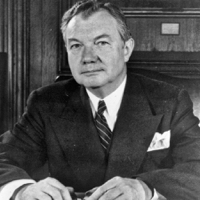
“The prosecutor has more control over life, liberty, and reputation than any other person in America. His discretion is tremendous. He can have citizens investigated and, if he is that kind of person, he can have this done to the tune of public statements and veiled or unveiled intimations.
“Or the prosecutor may choose a more subtle course and simply have a citizen’s friends interviewed. The prosecutor can order arrests, present cases to the grand jury in secret session, and on the basis of his one-sided presentation of the facts, can cause the citizen to be indicted and held for trial. He may dismiss the case before trial, in which case the defense never has a chance to be heard.
“Or he may go on with a public trial. If he obtains a conviction, the prosecutor can still make recommendations as to sentence, as to whether the prisoner should get probation or a suspended sentence, and after he is put away, as to whether he is a fit subject for parole.
“While the prosecutor at his best is one of the most beneficent forces in our society, when he acts from malice or other base motives, he is one of the worst….”
– From an address by Attorney General Robert H. Jackson to the Conference of United States Attorneys, Washington, D.C., April 1, 1940
Although Jackson’s cautionary words were directed toward federal prosecutors, they could hardly be more applicable to the State of North Carolina’s prosecution of the Edenton Seven. H.P. Williams Jr., Bill Hart and Nancy Lamb surely missed no chance to put forth “veiled or unveiled intimations,” to make a “one-sided presentation” or to otherwise act “from malice or other base motives.”

Holocaust child-survivors needed no coaxing
 June 22, 2012
“Teen-age Holocaust victims had no trouble looking their abusers straight in the face and saying, ‘You did this to me, you monster.’ None of them, when they were younger, had to have any of their memories elicited. Nor were there embellishments of clowns throwing fire around the room.
“The author of a book on Holocaust survivors, ‘New Lives,’ had this to say: ‘I interviewed hundreds of Holocaust survivors. Would that they could forget anything. At age 4, at age 5 they remembered everything on the SS officers’ uniforms.’ ”
“The author is the Wall Street Journal’s Dorothy Rabinowitz, the first journalist to provide the same in-depth reportage about Fells Acres that ‘Frontline’ provided about Little Rascals and Abby Mann did for the McMartin trial in an HBO movie.”
– From “Abusing Justice, in the Name of Children” by Ed Siegel in the Boston Globe (September 8, 1995)
Clemency now rare; is it fear of blowback?
 Dec. 8, 2013
“Obviously, there’s a modern trend towards more limited use of executive clemency that extends beyond the current president. I speculate that the increased media scrutiny given to pardons and commutations has made presidents reluctant to exercise clemency…..
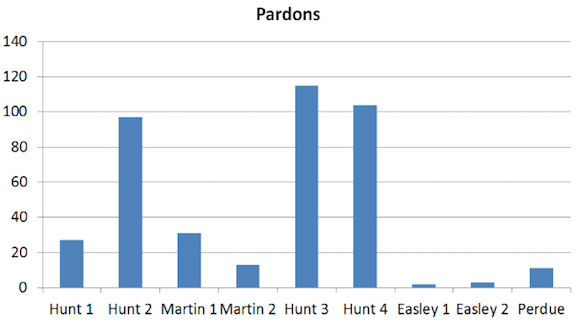
“The same trend… may be present in North Carolina as well…. Most of Governor Easley’s pardons were in cases in which DNA evidence exonerated the defendant, while almost all of Governor Perdue’s pardons concerned the racially tainted Wilmington 10 cases…. It is too early to tell how much, or how little, Governor McCrory will exercise executive clemency.”
– From “Do Only Turkeys Get Pardons?” by Jeff Welty at the North Carolina Criminal Law blog (Dec. 5)
The chart above, compiled by Welty, a faculty member at the University of North Carolina School of Government, depicts poignantly the odds faced by Junior Chandler and others pursuing clemency from recent North Carolina governors.
Since Jim Hunt left office in 2001, pardons have become historically scarce, paralleling the drop-off at the presidential level. But that smattering of clemency, as Welty points out, is most like to occur in December, under cover of the Christmas spirit.
All molesters, please gather now on E. Eden Street
June 15, 2012
“How did such a large group of child molesters assemble? This is not New York, this is Edenton, North Carolina.”
– Edward B. Simmons, making his closing argument on behalf of Dawn Wilson (Jan. 14, 1993)