
Rascals case in brief
In the beginning, in 1989, more than 90 children at the Little Rascals Day Care Center in Edenton, North Carolina, accused a total of 20 adults with 429 instances of sexual abuse over a three-year period. It may have all begun with one parent’s complaint about punishment given her child.
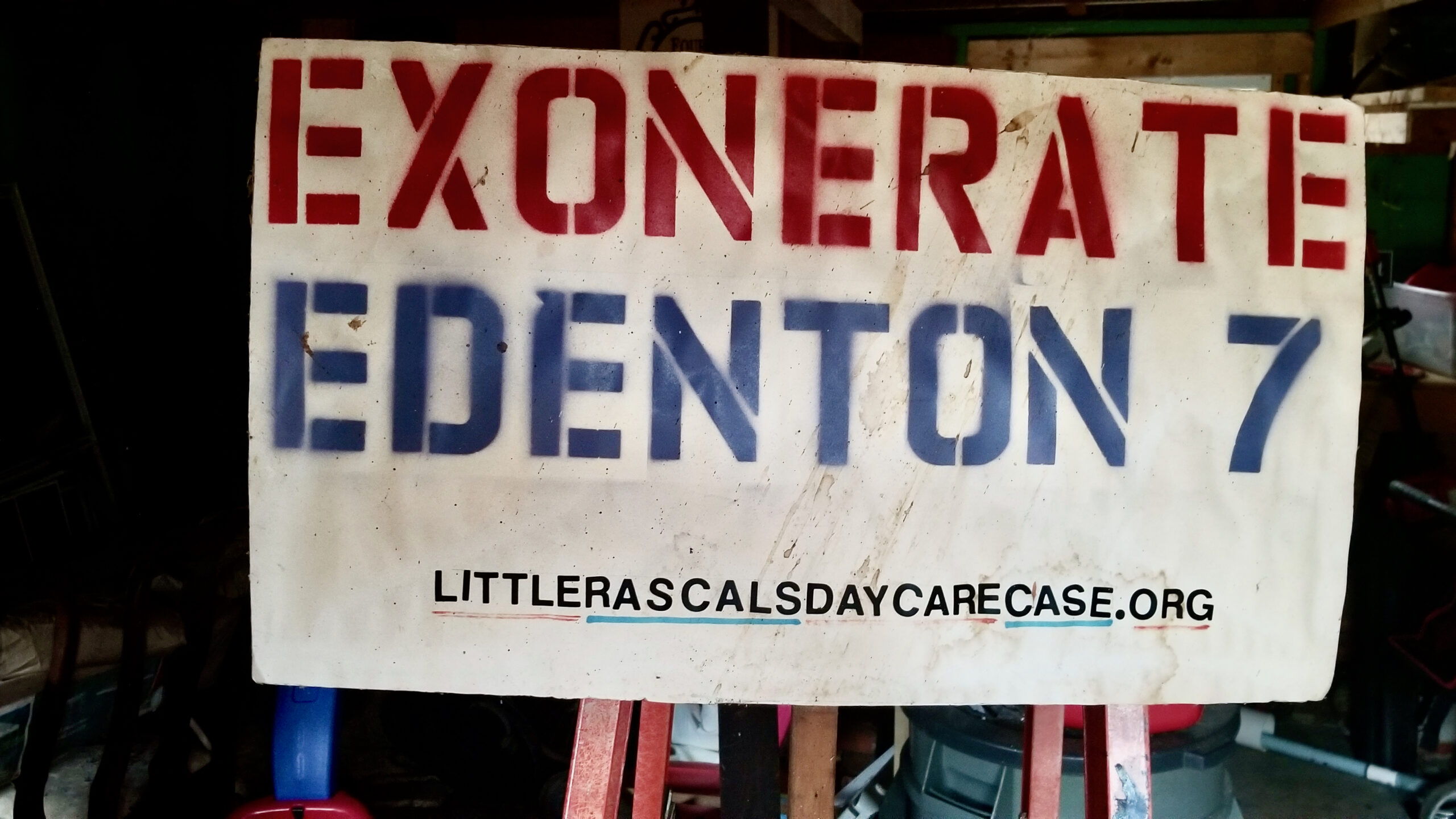
Among the alleged perpetrators: the sheriff and mayor. But prosecutors would charge only Robin Byrum, Darlene Harris, Elizabeth “Betsy” Kelly, Robert “Bob” Kelly, Willard Scott Privott, Shelley Stone and Dawn Wilson – the Edenton 7.
Along with sodomy and beatings, allegations included a baby killed with a handgun, a child being hung upside down from a tree and being set on fire and countless other fantastic incidents involving spaceships, hot air balloons, pirate ships and trained sharks.
By the time prosecutors dropped the last charges in 1997, Little Rascals had become North Carolina’s longest and most costly criminal trial. Prosecutors kept defendants jailed in hopes at least one would turn against their supposed co-conspirators. Remarkably, none did. Another shameful record: Five defendants had to wait longer to face their accusers in court than anyone else in North Carolina history.
Between 1991 and 1997, Ofra Bikel produced three extraordinary episodes on the Little Rascals case for the PBS series “Frontline.” Although “Innocence Lost” did not deter prosecutors, it exposed their tactics and fostered nationwide skepticism and dismay.
With each passing year, the absurdity of the Little Rascals charges has become more obvious. But no admission of error has ever come from prosecutors, police, interviewers or parents. This site is devoted to the issues raised by this case.
On Facebook


Little Rascals Day Care Case
This Facebook page is an offshoot of littlerascalsdaycarecase.org, which addresses the wrongful prosecution of the Edenton Seven and other such victims.

Meanwhile in Edenton....
This content isn't available right now
When this happens, it's usually because the owner only shared it with a small group of people, changed who can see it or it's been deleted.0 CommentsComment on Facebook
Allies for our cause!
This content isn't available right now
When this happens, it's usually because the owner only shared it with a small group of people, changed who can see it or it's been deleted.0 CommentsComment on Facebook
The courts have a long history of capriciously pulling the rug out from under Junior's appeals, but maybe this time....
This content isn't available right now
When this happens, it's usually because the owner only shared it with a small group of people, changed who can see it or it's been deleted.0 CommentsComment on Facebook
Click for earlier Facebook posts archived on this site
Click to go to

Today’s random selection from the Little Rascals Day Care archives….
‘Prosecutors’ Overreaching’? Edenton had it in spades
Aug. 27, 2012
“Prosecutors are the most powerful officials in the criminal justice system. They decide whether criminal charges should be brought and what those charges should be, and they exercise almost boundless discretion in making those decisions. Prosecutors alone decide whether to offer the defendant the option of pleading guilty to reduced charges….
“Equally problematic is that the charging and plea-bargaining decisions are made behind closed doors, and prosecutors are not required to justify or explain these decisions to anyone…. The lack of transparency also leads to misconduct, like the failure to turn over exculpatory evidence – a common occurrence made famous by the prosecutors in the Duke lacrosse and Senator Ted Stevens cases.”
– From “Prosecutors’ Overreaching Goes Unchecked” by Angela J. Davis in the New York Times (Aug. 19)
Prosecutors plea-bargained cruelly though futilely with the Edenton Seven. And while the evidence-withholding in the Duke and Stevens cases may have made bigger headlines, it was no more flagrant than in Little Rascals.
One example from the North Carolina Court of Appeals order overturning Bob Kelly’s conviction (May 2, 1995):
“Judge L. Bradford Tillery, a pretrial Judge, directed the State to file and present for in camera review identifying information, medical and psychotherapeutic files and DSS files with respect to the ‘indictment children’….
“In apparent compliance with Judge Tillery’s order… the State turned over a box of files to the trial court, Judge McLelland presiding. The box contained, inter alia, complete medical notes and therapy notes on the 29 indictment children, 12 of whom testified at defendant’s trial and 17 of whom did not….
“After trial, defendant’s appellate counsel went to the Office of the Clerk of Court for Pitt County to view the exhibits. He opened several boxes containing trial exhibits, none of which were sealed. One of the boxes contained 29 files labeled with the names of the indictment children. Appellate counsel reviewed some of the documents contained in the files before requesting the box to be sealed and transmitted to the Court of Appeals…. Defendant argues that the files contained undisclosed information that would have been material to the defense.”
In fact, the withheld files were bulging with exculpation – conflicting claims, evidence of hysteria, eyewitness testimony that nothing happened. Countless other examples are documented in Bob Kelly’s appeal brief.
Attorney General Mike Easley bridled at the appeals court’s concern over such “small areas… none of which are very significant.” And, after all, as prosecutor Bill Hart had asked smirkingly during the trial, “If you were playing poker, would you be playing with your full hand showing?”
The truth about justice – as seen on TV!

Jan. 29, 2016
“The release last month of ‘Making a Murderer’ capped a year in which popular culture’s portrayal of the criminal justice system seems to have shifted. Out with the old tropes about truth-seeking investigators and tidy resolutions; in with the disquieting, dysfunctional reality of many courtrooms and police stations….
“Yes, post-conviction DNA testing and the work of Innocence Projects around the country have exonerated more than 1,700 defendants. Those cases heighten awareness of potential errors and demonstrate that wrongful convictions happen. But Americans shouldn’t expect certainty about innocence. Sometimes the focus on finding new evidence to exonerate distracts from the question of whether the old evidence proved guilt….
“Fewer than 70,000 federal felonies are prosecuted each year, while roughly 2.5 million felonies proceed through the state courts. Many state cases involve near-simultaneous investigation and prosecution. One rarely finds out ‘what really happened.’
“The prosecutor in Avery’s trial argued in his closing statement that ‘reasonable doubts are for innocent people.’ They are not. And procedural protections like access to defense counsel and freedom from coerced interrogations extend to both the innocent and the guilty. The real contribution of these documentaries is not to ask ‘whodunit’ but to reveal what was done to defendants….
“The United States criminal justice system needs fewer guilt-assuming interrogation tactics, more disclosure of potentially exculpatory information to the defense, expanded oversight units within prosecutors’ offices to investigate potential miscarriages of justice and fuller appellate scrutiny of convictions.
“The moment is ripe for reform, culturally and politically….”
– From by “ ‘Making a Murderer’ Is About Justice, Not Truth” by Lisa Kern Griffin, Duke Law professor and former federal prosecutor, in the New York Times (Jan. 12)
Will this heightened skepticism about the nation’s justice system ever trickle down to exonerate the Edenton Seven and free Junior Chandler?

Dog bites man: ‘Paper will not be retracted’
 Aug. 26, 2015
In November 2012 the journal Nursing Research declined my request to retract Susan J. Kelley’s 1990 article based on the existence of “satanic ritual abuse” in day cares. The editor contended that “Conditions that would lead to a retraction are not present.”
Nursing Research having since installed a new editor, I recently tried again. This time I was able to include two important academic developments: Richard Noll’s expose of the “satanic ritual abuse” movement in Psychiatric Times and Dr. Allen Frances’ personal apology for failing to do more to challenge that movement.
This is an excerpt from the response I received from editor Susan J. Henly, professor emerita, University of Minnesota School of Nursing:
“As I understood it, your argument for retraction (of ‘Parental Stress Response to Sexual Abuse and Ritualistic Abuse of Children in Day-care Centers’) was based on the rationale that: the title embraced and promoted the existence of ritual sexual abuse in day cares that did not exist, and that not a single respected academic or professional would be willing to give credence to claims about ritualistic sexual abuse from the times during which the research was conducted.
“In response, I re-read Kelley et al. (1990) many times, reviewed background information, contacted the author, and communicated with the editor of another journal that has published papers on child sexual abuse by Dr. Kelley. Documents related to the original peer review of the Nursing Research paper are not available, and the Editor (Dr. Florence Downs) who accepted the paper is deceased.
“I searched for other papers on this topic from the 1980s to the present and did not locate any, including other original research by Dr. Kelley, that had been retracted. I discussed the methods of the research with Dr. Kelley; she verified what was stated in the paper, which I found to be in accord with expectations for scientific standards and ethical conduct of research. The editor I contacted about a related paper said the journal stood by the integrity of their review process and quality of the scholarship that had been published.
“With regards to issues related to credence of claims about ritualistic sexual abuse, Finkelhor, Williams, Burns, & Kalinowski (1988) included this sort of abuse in their national study of sexual abuse in day care. More recently, Salter (2013) provided a critical overview of debates arising from allegations of organized sexual abuse and addressed issues related to terminology. (Dr. Michael Salter is Senior Lecturer in Criminology at the University of Western Sydney). Also, a book by (Ross) Cheit (2014) summarized scholarly work that uses empirical data to challenge the view that cases from the 1980s were based on moral panic of the type described in your message. (Dr. Cheit is Professor of Political Science and Public Policy at Brown University.)
“Findings from the many papers (thousands) in the peer-reviewed literature focused on the forensic, sociological, political, family and health aspects of child sexual abuse will no doubt, with time, contribute to better understanding that can be used to keep children from harm as well as protect the rights of those wrongly accused – both issues that are of critical importance to all citizens.
“Retraction is a mechanism for correcting the literature and alerting readers to publications that contain such seriously flawed or erroneous data that their findings and conclusions cannot be relied upon (Committee on Publication Ethics, n.d.). Criteria for retraction of a paper include: clear evidence that findings were unreliable, the paper was redundant or plagiarized, or the research was conducted unethically.
“Using the process described above, I did not find evidence of any of these concerns in Kelley (1990). For this reason, the paper will not be retracted.”
Dr. Henly’s rejection letter is thoughtful and earnest, and I appreciate the time and effort it required. Some editors would’ve simply ignored me. But it is far too narrow, blindered to the big picture. This is from my response to her:
“The ‘satanic ritual abuse’ day-care moral panic is prominently in the news media these days with publication of ‘We Believe the Children: A Moral Panic in the 1980s” by Richard Beck. Unlike Ross Cheit’s revisionist “The Witch-Hunt Narrative,’ Beck’s book already has been positively reviewed in such periodicals as the New York Times (twice), the Wall Street Journal and the Washington Post. It is the long-awaited standard history of this era, and it establishes clearly that “satanic ritual abuse” was no more than a toxic myth.
“Your citations in defense of Dr. Susan J. Kelley’s article do nothing to disqualify your first criterion for retraction: ‘clear evidence that findings were unreliable.’
“The ‘ritualistic abuse of children in day-care centers’ motivating the article simply never happened – what evidence of unreliability could be clearer?
“Would Dr. Kelley today argue otherwise?”
Psychiatrist’s theory bolstered day-care prosecutions
Feb. 2, 2019
First of two parts
The name of Dr. Roland Summit, key supporter of the McMartin Preschool prosecution, no longer resonates in psychiatry, but the “child sexual abuse syndrome” he conjured up did a lifetime’s worth of damage to its countless victims.

As described by Debbie Nathan (Village Voice, Jan. 12, 1990), “[Summit’s] theory about incest… argues that if there is evidence of sex abuse and a child denies it, this is only further proof that it happened and a therapist should use any means necessary to help the child talk…. If they later recant, that means they are under family pressure to protect the father and their turnabout is further proof of the crime.
“So no matter how much coercion was used to get an accusation and no matter if a child later retracted it, once Summit’s incest theory was applied, a charge of abuse became irrefutable. Child protection workers ignored the fact that this logic had little to do with day care. After all, why would children staunchly defend abuse to protect an adult who wasn’t part of the family? And if they had been so brutally attacked at school, why wouldn’t they tell their parents?
“Therapists and investigators came up with all sorts of rationales. One was the teachers threatened them by slaughtering animals and warning that the same thing would happen to their parents if they told….”
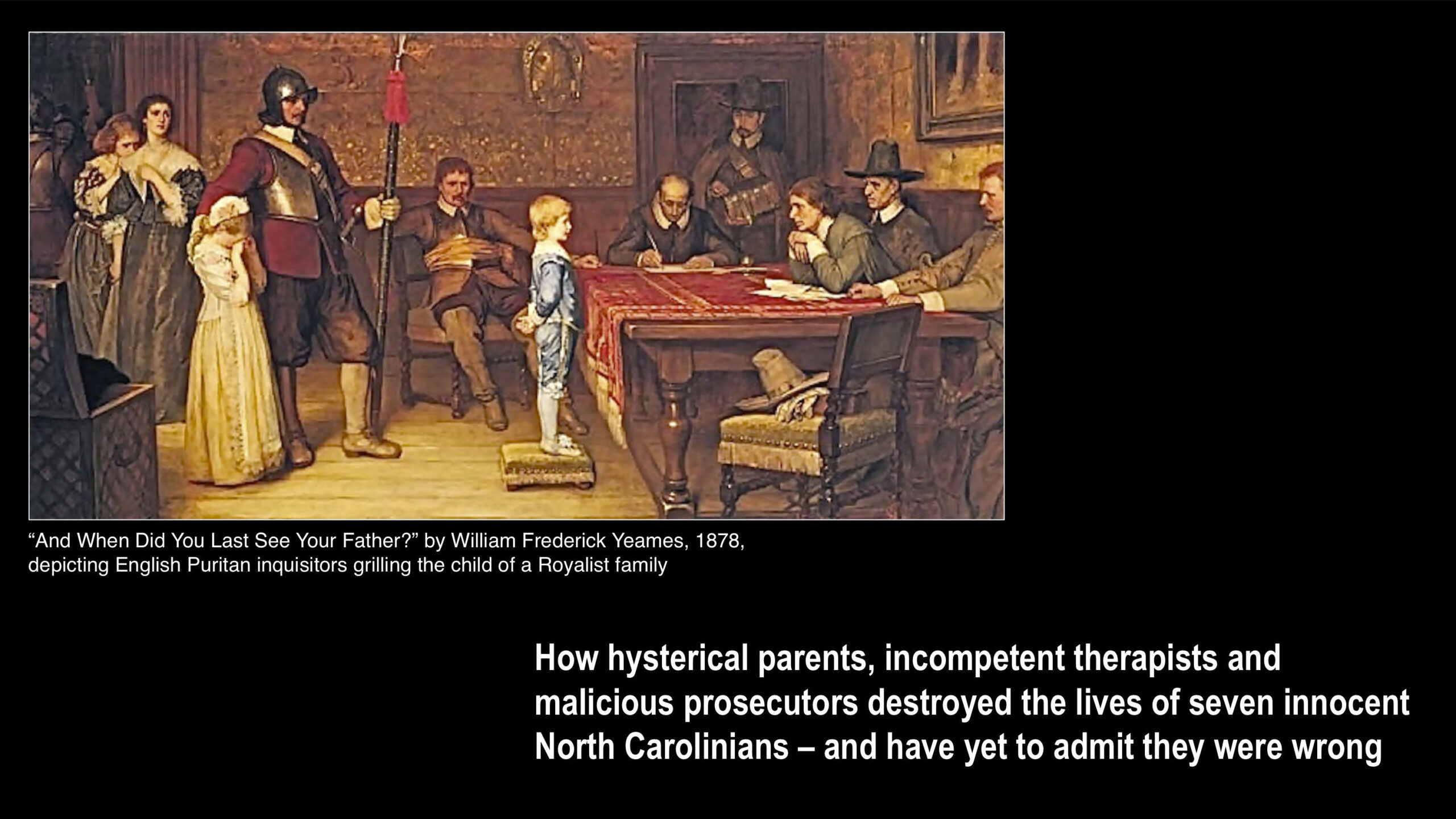
Summit wasn’t among the expert witnesses in the Little Rascals Day Care case, but his supposed syndrome warped therapists’ interpretation of every child-witness interview. And those imaginary “threatened parents” showed up in this 1995 open letter from Little Rascals parents: “Many [children are now] old enough to realize that Bob Kelly can’t work his threatened evil to kill their families.”
Next: Collusion by psychiatrist and patient