

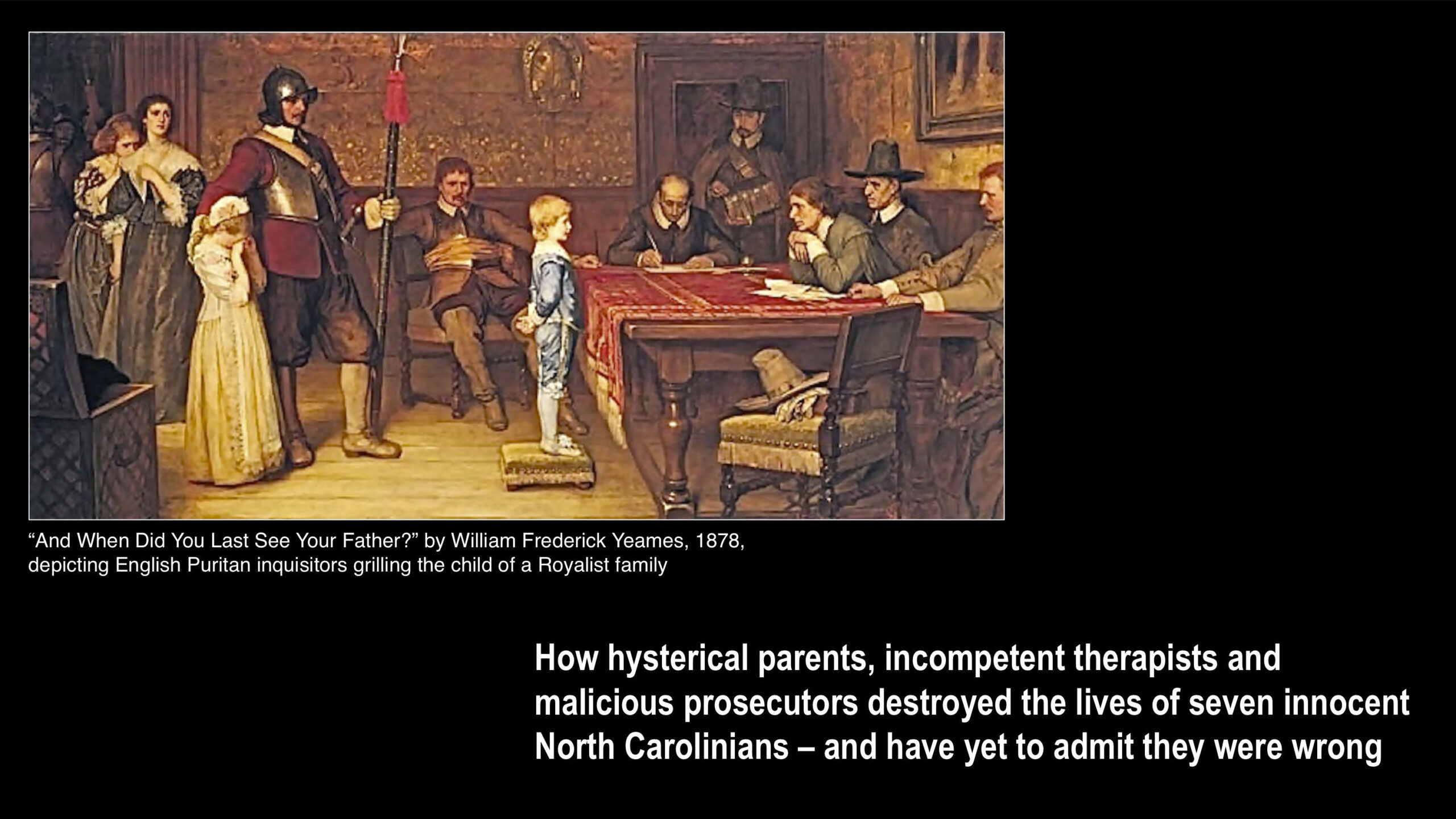

Rascals case in brief
In the beginning, in 1989, more than 90 children at the Little Rascals Day Care Center in Edenton, North Carolina, accused a total of 20 adults with 429 instances of sexual abuse over a three-year period. It may have all begun with one parent’s complaint about punishment given her child.
Among the alleged perpetrators: the sheriff and mayor. But prosecutors would charge only Robin Byrum, Darlene Harris, Elizabeth “Betsy” Kelly, Robert “Bob” Kelly, Willard Scott Privott, Shelley Stone and Dawn Wilson – the Edenton 7.
Along with sodomy and beatings, allegations included a baby killed with a handgun, a child being hung upside down from a tree and being set on fire and countless other fantastic incidents involving spaceships, hot air balloons, pirate ships and trained sharks.
By the time prosecutors dropped the last charges in 1997, Little Rascals had become North Carolina’s longest and most costly criminal trial. Prosecutors kept defendants jailed in hopes at least one would turn against their supposed co-conspirators. Remarkably, none did. Another shameful record: Five defendants had to wait longer to face their accusers in court than anyone else in North Carolina history.
Between 1991 and 1997, Ofra Bikel produced three extraordinary episodes on the Little Rascals case for the PBS series “Frontline.” Although “Innocence Lost” did not deter prosecutors, it exposed their tactics and fostered nationwide skepticism and dismay.
With each passing year, the absurdity of the Little Rascals charges has become more obvious. But no admission of error has ever come from prosecutors, police, interviewers or parents. This site is devoted to the issues raised by this case.
On Facebook


Little Rascals Day Care Case
This Facebook page is an offshoot of littlerascalsdaycarecase.org, which addresses the wrongful prosecution of the Edenton Seven and other such victims.

Meanwhile in Edenton....
This content isn't available right now
When this happens, it's usually because the owner only shared it with a small group of people, changed who can see it or it's been deleted.0 CommentsComment on Facebook
Allies for our cause!
This content isn't available right now
When this happens, it's usually because the owner only shared it with a small group of people, changed who can see it or it's been deleted.0 CommentsComment on Facebook
The courts have a long history of capriciously pulling the rug out from under Junior's appeals, but maybe this time....
This content isn't available right now
When this happens, it's usually because the owner only shared it with a small group of people, changed who can see it or it's been deleted.0 CommentsComment on Facebook
Click for earlier Facebook posts archived on this site
Click to go to

Today’s random selection from the Little Rascals Day Care archives….
High school students introduced to ‘Innocence Lost’

June 10, 2016
It’s heartening to see that, 25 years later, “Innocence Lost” is still shining light on the wrongful prosecution of the Edenton Seven – and for a younger audience! This is a note from Judy Griffin, a teacher at Hamilton High School in Michigan, who recently rediscovered Ofra Bikel’s eight-hour masterpiece:
“I want you to know how helpful it is (to have “Innocence Lost” available online). I teach in a resource room English class. The kids have no cognitive issues, but reading is a tremendous struggle. When they can receive the information through really good videos like this one, we can cover some great information.
“We start by reading Edward R. Murrow’s introduction to ‘This I Believe.’ Then the students create digital versions of their own. After that, they view ‘Good Night, and Good Luck.’ They have just learned about McCarthyism at this point in U.S. History, so it is fresh in their minds.
“We move then into The Crucible. The students are then asked to compare this to ‘Good Night, and Good Luck.’ They read ‘Why I wrote The Crucible’ by Arthur Miller.
“At the conclusion, we talk about how these hysterias are repeated and actually happened even prior to Salem. I introduce the Day Care scandal, and was thrilled to find the original ‘Frontline’ episodes. I had seen it when it aired!
“They are now researching various aspects of the hysteria. Some are looking at ‘satanic ritual abuse,’ some are looking at how hysteria spreads, some are researching what happened to the various defendants, and some are looking at the causes. We emphasize that this is not unique to any of these situations, and the point of this all is to show how vulnerable societies are to hysteria….”

Some journals getting better at correcting mistakes
 March 9, 2017
“As a result of complaints, [scientific] journals have been posting notices of problems with Dr. [Carlo] Croce’s papers at a quickening pace. From just a handful of notices before 2013 – known as corrections, retractions and editors’ notices – the number has ballooned to at least 20, with at least three more on the way, according to journal editors….”
– From “Years of Ethics Charges, but Star Cancer Researcher Gets a Pass” by James Glanz and Agustin Armendariz in the New York Times (March 8)
Yet another example of professional journals responding with new vigor to faulty articles.
By contrast, no retraction has ever appeared in those journals that lent credence to testimony by the prosecution’s expert witnesses during the day-care panic. Or perhaps some author or editor still wants to defend the likes of “Stress Responses of Children to Sexual Abuse and Ritualistic Abuse in Day Care Centers” and “Satanic Ritual Abuse: A Cause of Multiple Personality Disorder”?
How were defendants so skillful at dressing kids?
Nov. 30, 2011
 “You have to start with the matter of probability. What every one of these (day care sex abuse) cases has in common is that no adult observer has actually seen a molestation in progress.
“Supposedly, these abuses are going on continually over a period of months. Almost always, they supposedly involve a number of adults and many children, with outsiders constantly walking in and out of these centers. Yet we have no corroborating eyewitnesses. None….
“Throughout it all, these children somehow always come home in the right shoes and socks and underpants. Do you have kids? Do you realize how hard it is to dress two kids in a hurry without some kind of mix-up, let alone 10 or 12 or 20 kids?”
– Dr. Richard A. Gardner, clinical professor of psychiatry at Columbia University, quoted in Playboy magazine (June 1992)
Psychiatric Times clings to embarrassing position
 Feb. 14, 2014
Thanks to Ivan Oransky at Retraction Watch for spotlighting Psychiatric Times’ remarkably inept retraction of Richard Noll’s “When Psychiatry Battled the Devil.”
Don’t miss the update appended by Dr. Noll:
“On 16 January 2014 I received a gracious email from PT’s editor-in-chief, Dr. James Knoll, updating me on the status of my submission. This message cleared up the mystery of the published article’s disappearance from PT.
“According to Dr. Knoll, ‘In an effort to present both sides, PT contacted Dr. (Richard) Kluft (of Philadelphia). Please know that not only did he take exception to a number of your points, but he also raised the issue of legal liability. We are currently in the process of confirming that Dr. Kluft is willing to write a rejoinder to your piece.’
“Apparently he refused. About 10 days later I received another email from Dr. Knoll telling me that the reposting of my piece was to be put on hold at the advice of their attorneys. He did not outright reject the possibility it would be reposted, but I have heard nothing since….”
Followers of Retraction Watch – or even of littlerascalsdaycarecase.org – are not surprised to see editors go to absurd lengths to avoid candid correction. But the behavior of Psychiatric Times, billed as the most widely read psychiatric publication and boasting a lengthily-credentialed editorial board, seems especially unbecoming – even pusillanimous.
Dr. Kluft? Dr.Knoll? Can’t you do better?